Geography · 8 min read · September 2026
Bacalar or Tulum? Choosing Between the Lagoon and the Coast
Fresh water or salt, quiet or known, retreat or scene. A side-by-side reading of two very different places people fall for — and how to tell which one is actually yours.

By Ivan Dominguez
Real Estate Agent · LL.M., at (UIBE)
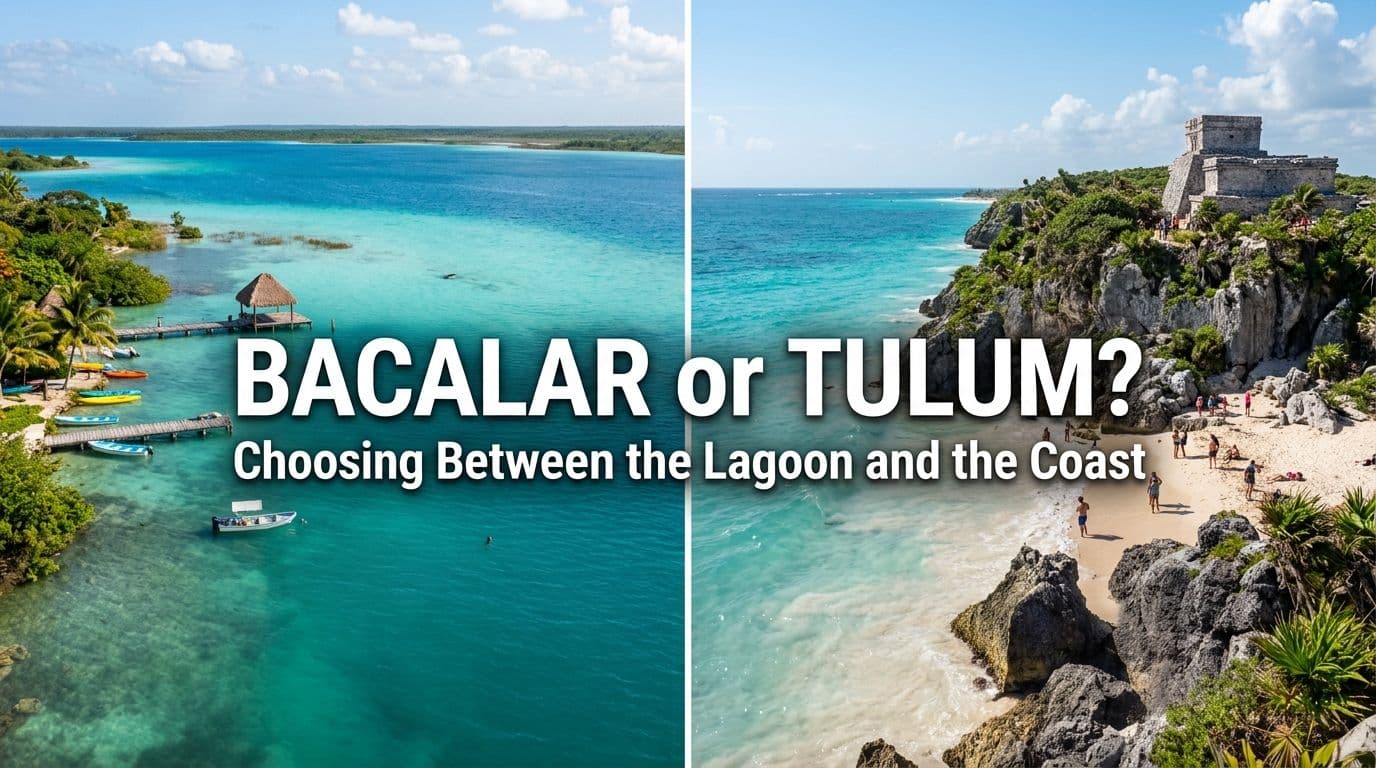
They come up together more often than you'd think, usually from the same person on the same call. Bacalar or Tulum? They're a few hours apart and almost opposites — one a freshwater lagoon, the other a famous coast. Choosing between them is really choosing between two kinds of life.
Tulum: the coast and the crowd
Tulum is salt water, white sand, and a name the whole world recognizes. With the attention came an airport, a design culture, restaurants, and demand — and also traffic, strained services, and prices that increasingly assume a story. It's energetic, social, and unmistakably on the map.
If what you want is to be near a particular scene and a particular kind of architecture, and you're willing to do the homework that protects you in a hot market, Tulum can still be worth it — at the right parcel.
Bacalar: the lagoon and the quiet
Bacalar is the opposite kind of beautiful. The water is fresh, the lagoon glows in bands of blue, and the days are slow and still. It's further from everything, quieter, and far less built — closer to where Tulum was twenty years ago than to where Tulum is now.
People choose Bacalar for retreat rather than scene: a place to swim at dawn, to bring the family back to, to exhale. The scarcity of titled lagoon-front does the rest.
Cost, access, and pace
Tulum costs more and moves faster, with better flight access and more services already in place. Bacalar costs less, moves slower, and rewards patience — Chetumal's airport and a new Tren Maya stop are steadily closing the distance.
Neither is 'better.' They're answers to different questions, and the honest one to ask yourself is which question you're really asking.
What the Official Numbers Show
Everything above is true, but it's also a feeling. Here's what the numbers actually say — from Quintana Roo's own tourism board, comparing Bacalar and Tulum survey to survey, not a broker's pitch.
Bacalar is still small next to Tulum — genuinely small. In 2025, an estimated 252,000 tourists stayed in Bacalar; Tulum received close to 1.68 million. Bacalar's tourism spending for the year came to roughly $92 million USD, against Tulum's $1.89 billion. However you cut it, Bacalar today runs at somewhere between 5% and 15% of Tulum's scale — this isn't a market that's already been discovered.
But the Tren Maya is already treating it differently. In 2025, roughly 48,000 domestic passengers got off the train in Bacalar — about 70% of the roughly 68,000 who disembarked in Tulum. A station moving passenger volume that much closer to Tulum's than the tourism numbers above would predict reads less like a coincidence and more like infrastructure arriving ahead of the market catching up to it.
Hotel occupancy backs that up. Average occupancy through 2024 ran 57% in Bacalar against 73% in Tulum — real headroom before Bacalar reaches the kind of saturation Tulum is already managing.
A trip to Tulum still costs roughly double. Per the official Q1 2026 visitor surveys, the average group spent $1,285 USD total on a Tulum trip, versus $629 in Bacalar. Tulum wins almost every guest-experience score too — restaurants (94), tours (92), beaches (90) all rate higher than Bacalar's (82, 82, 78) — which tracks with a more built-out destination.
Except on the one number that matters most: security. There it's a tie. Both destinations scored 84 out of 100 on security satisfaction in their respective Q1 2026 surveys — identical. That's a self-reported index, not a crime statistic, but Bacalar matching Tulum's number despite a fraction of its size and infrastructure is worth noting on its own.
And once visitors are in Bacalar, they're spending more locally — the opposite of what's happening in Tulum. In-destination spend (restaurants, tours, shopping) rose 27% in Bacalar year over year, from $213 to $271. In Tulum, that same figure fell 9%, from $236 to $214, even as total trip spend climbed. Bacalar's visitors are staying shorter (5.5 days on average, up from 5.2) than Tulum's (8.3 days, down from 8.6) — but spending more of what they do spend inside the destination itself.
Bacalar's growth right now is mostly a Mexican story — Tulum's isn't. 75% of Bacalar's Q1 2026 visitors were Mexican nationals, versus just 17% of Tulum's; Tulum's mix skews heavily international (36% U.S., 27% Europe). Bacalar's international share is real and rising — U.S. visitors from 8.0% to 9.4%, Europe from 7.3% to 10.4% — but it's coming from a much smaller base. If Bacalar's visitor mix moves toward Tulum's over the next few years, that's a specific, trackable thing to watch, not a guess.
And a lot of everyone showing up is new. 64.9% of Bacalar's Q1 2026 visitors had never been to the Mexican Caribbean before, up sharply from 29.6% a year earlier — the fastest-growing first-timer share of the two destinations (Tulum's moved from 51.0% to 61.7% over the same period).
None of this is a promise about what happens to property values. It's the closest thing to an honest, third-party account of where Bacalar actually stands today: smaller than Tulum, less built-out, and rated lower on almost every guest-experience score — but tied on safety, gaining local spend while Tulum is losing it, and already carrying Tren Maya traffic that its current tourism size doesn't fully explain.
Sources: Consejo de Promoción Turística de Quintana Roo (CPTQR), Perfil y Comportamiento del Turista — Bacalar and Tulum, January–March 2026; Secretaría de Turismo del Estado de Quintana Roo, tourist arrival, economic impact, hotel occupancy, and Tren Maya ridership estimates, 2024–2025.
If the trajectory above is what's pulling you toward Bacalar, the real question becomes what's actually available today — see Houses in Bacalar for current inventory, pricing, and availability.
How to choose
Choose by the life you picture, not the postcard. If it's stillness, fresh water, and a long family horizon, Bacalar tends to win. If it's the coast, the design, and being close to a known scene, Tulum can be worth its premium — after real diligence.
And if you're torn, that usually means the answer is a quiet drive up and down both, not a faster decision. We're glad to make that drive with you.
- Is Bacalar growing faster than Tulum, or is it just smaller?
- Smaller, by a wide margin — Bacalar's 2025 tourist volume was roughly 15% of Tulum's, and its tourism spending closer to 5%. What stands out is the Tren Maya: Bacalar's station handled about 70% of the passenger volume Tulum's did in 2025, well ahead of what its overall tourism size would predict. That's a sign infrastructure is arriving before the market has caught up to it, not evidence Bacalar has already overtaken anything.
- How does what visitors spend in Bacalar compare to Tulum?
- Tulum is still the bigger spend — $1,285 USD per group on average in Q1 2026, versus $629 in Bacalar, according to the official visitor surveys. But the direction is different: spend inside the destination itself (restaurants, tours, shopping) grew 27% in Bacalar year over year, while it fell 9% in Tulum over the same period.
- Is Bacalar actually safe?
- According to the same official surveys, Bacalar and Tulum scored identically on security satisfaction in Q1 2026 — 84 out of 100 each. It's a self-reported index, not a crime statistic, but the fact that Bacalar ties Tulum's number despite being a much smaller, less built-out destination is worth noting.
- Are most of Bacalar's visitors Mexican or international?
- Mostly Mexican, for now — 75% of Q1 2026 visitors were Mexican nationals, versus just 17% in Tulum, where the mix is dominated by U.S. (36%) and European (27%) visitors. Bacalar's international share is growing (U.S. visitors rose from 8.0% to 9.4%, Europe from 7.3% to 10.4%), but it's still early in that shift compared to Tulum.